A transferência de ficheiros confidenciais entre locais geográficos através de redes não seguras exige que se tenham em conta aspetos de segurança relativos à integridade dos ficheiros, à segurança da rede e à segurança dos ativos, de modo a garantir que os ficheiros não foram comprometidos. Da mesma forma, as redes confidenciais e os sistemas de infraestruturas críticas têm de ser protegidos contra possíveis intrusões.
Diodos de dados e assinaturas digitais
Os díodos de dados têm sido tradicionalmente utilizados para garantir uma segurança física entre redes; no entanto, a transferência de ficheiros entre locais geográficos suscita preocupações de segurança tanto para o local de envio como para o de receção. Isto cria oportunidades para ataques do tipo «man-in-the-middle».
Para permitir a transferência segura de ficheiros entre localizações geográficas, os díodos de dados óticos OPSWAT utilizam uma combinação de assinaturas digitais, verificação de assinaturas e TLS mútuo. Uma solução típica inclui dois conjuntos de díodos óticos com assinaturas digitais aplicadas e, em seguida, validadas em cada etapa do fluxo de trabalho de transferência.
Como funcionam os fluxos de trabalho dos diodos de dados
Na demonstração que se segue, existem dois conjuntos de díodos óticos instalados no Local A (Azul A/Vermelho B) e no Local B (Azul B/Vermelho B), juntamente com os servidores de ficheiros já instalados nas redes de origem e de destino.
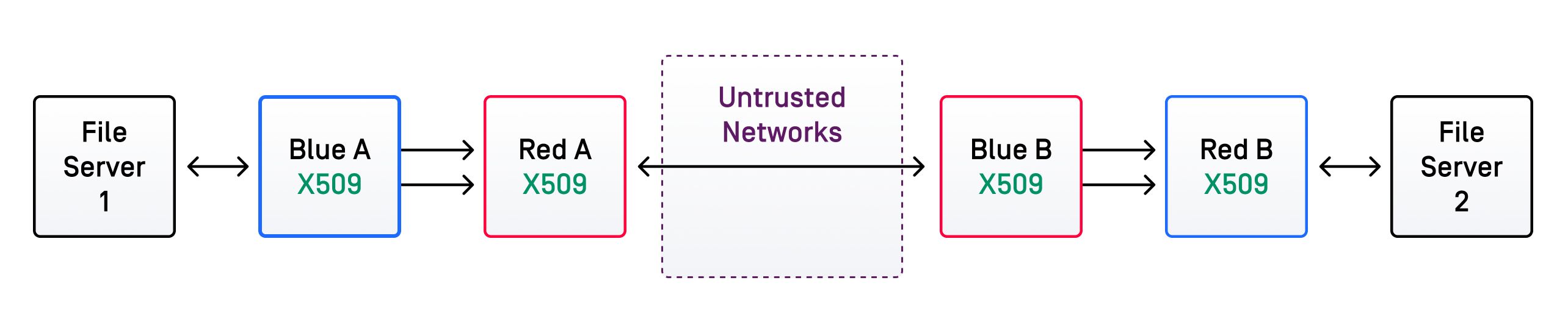
Optical Diode Azul A) copia umServer assinatura digital ao ficheiro recebido. Os utilizadores obtêm chaves de assinatura privada/pública de uma Autoridade Certificadora ou de um par de chaves autogerado. O Blue A assina o seu conteúdo com hash (SHA256) utilizando uma Chave Privada. O ficheiro, juntamente com os seus metadados que contêm a assinatura digital, é transferido através do diodo ótico do Blue A para o Red A.
Assim que o RED A verificar a assinatura digital do ficheiro recebido, o ficheiro, juntamente com os seus metadados, é transferido do RED A para o BLUE B através da rede não confiável. Para garantir a confidencialidade na rede não segura, é utilizado o TLS mútuo para proteger a comunicação entre os locais.
Depois de o BLUE B receber o ficheiro, verifica o hash e a assinatura para confirmar a integridade do ficheiro e, em seguida, transfere-o do BLUE B para o RED B, que verifica a assinatura do ficheiro utilizando a chave pública. Os ficheiros com assinaturas digitais válidas são entregues pelo RED B ao Server de ficheiros de destino Server .
Diodos de dados líderes do setor eOT Security unificadasOT Security
A combinação de díodos óticos com assinatura e verificação digitais, bem como a comunicação TLS mútua em redes não seguras, estabelece um quadro de segurança abrangente. Este quadro ajuda a garantir a integridade dos ficheiros e protege os ativos digitais críticos e as redes sensíveis.
As soluções MetaDefender oferecem uma transferência de dados unidirecional, garantida por hardware, entre redes de TI e OT, permitindo a replicação segura de dados e a visibilidade operacional sem comprometer o isolamento da rede.
Para saber mais sobre como a OPSWAT pode ajudar aOPSWAT a proteger as suas transferências de dados entre vários locais, fale hoje mesmo com um especialista.